
 +90 312 815 15 00
 optima@optima.tc


 Road Blockers
 Bollards
 Gate Operators
 Security Doors
 Sliding Gate
 Folding Gates
 Swing Gate
 Cantilevered Gates
 Arm Barriers
 Fence Systems
 Tyre Killers
 Armored Guard Houses
 Turnstiles
 Licence Plate Recognition System
 Parking Barriers
 Vehicle Recognition Systems
 Scada Application
 Parking Payment Systems
 Parking Systems
 Traffic Solutions
 About Optima
 Corporate Philosophy
 Our Mission and Our Vision
 CEO's Message
 Optima Milestones
 Why Optima?
 R&D and Innovation
 Awards and Achievements
 Exported Countries
 Human Resources

 Catalog
What is an Automatic Parking Barrier and How Does it Work?
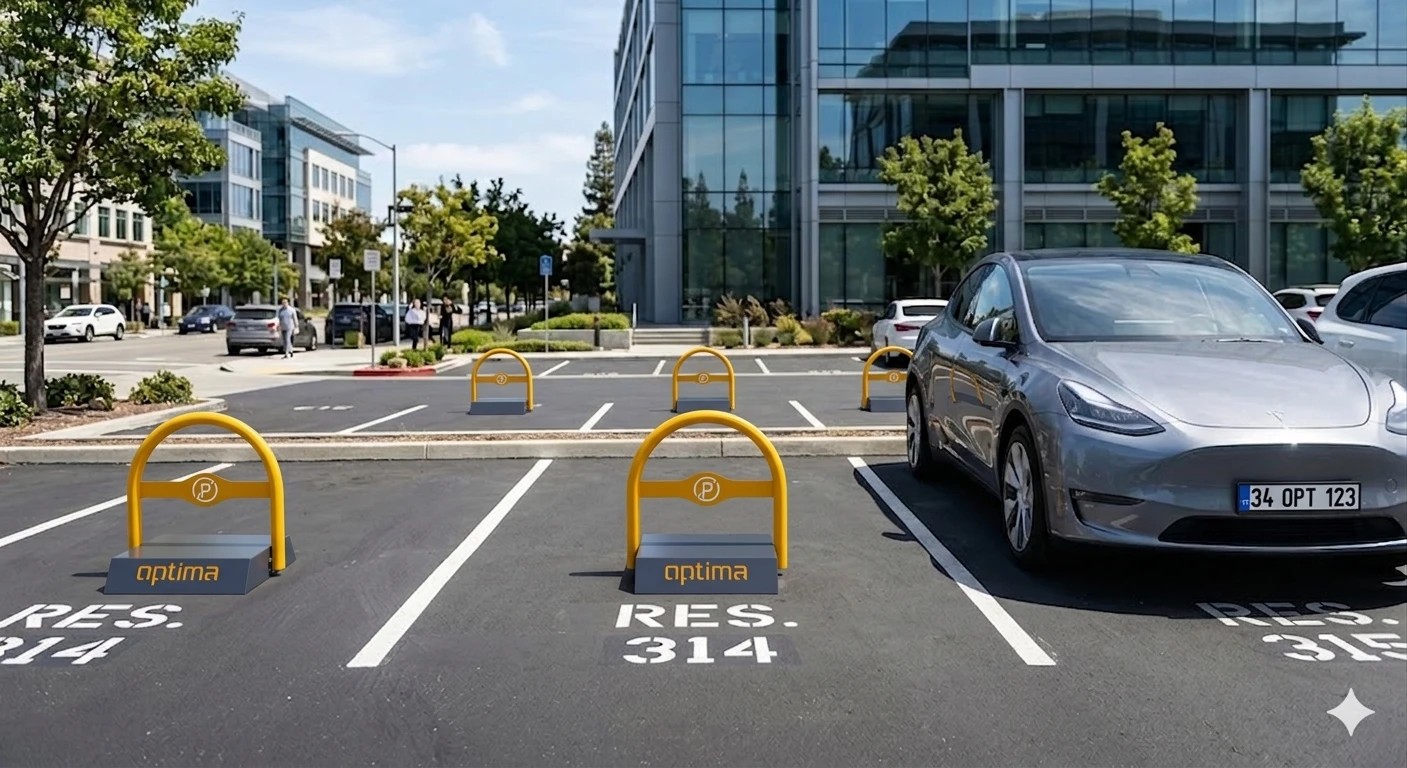
What Is an Automatic Parking Barrier? Types, Working Principle and Applications
As urbanization accelerates, the scarcity of parking space has become an ever-growing challenge. For apartment residents, property managers, business owners and shopping centre operators, securing a dedicated parking spot is no longer optional — it's a necessity. This is where the automatic parking barrier comes in: a smart solution that rises and lowers at the press of a button, physically prevents unauthorized parking and gives users complete control over their space.
In this article we cover what an automatic parking barrier is, which types are available, how it works and what to look for when choosing the right product.
What Is an Automatic Parking Barrier?
An automatic parking barrier is a motorized device fixed to the ground that prevents unauthorized vehicles from occupying a reserved parking space. When the driver leaves, the barrier rises and physically blocks the spot; when the driver returns, a single press of a button lowers it so the vehicle can park.
Its key advantage over traditional chain or manual barriers is that it requires no physical intervention and can be operated without leaving the vehicle — a critical comfort feature in rain, snow or for users with mobility impairments.
How Does an Automatic Parking Barrier Work?
The operating principle is straightforward yet effective:
1. Mechanical structure: Inside the barrier housing sits an electric motor and gear mechanism that moves the arm up and down. This assembly is fully enclosed within the ground-mounted body.
2. Control unit: An electronic control board drives the motor, issuing raise or lower commands in response to incoming signals. In Optima Engineering's PAS-100 automatic parking barrier, the entire mechanism is integrated into a compact housing.
3. Signal source: Triggers such as a remote control, smartphone application, card reader or keypad send commands to the control unit.
4. Power supply: Operates on mains electricity (220 V); selected models offer a built-in battery or solar panel backup against power outages.
5. Safety features: The barrier stops automatically if an obstacle is detected while lowering; when raised, it locks securely in the upright position — protecting both the vehicle and the user.
Types of Automatic Parking Barriers
Parking barriers fall into three main categories based on intended use and installation environment.
Automatic Personal Parking Barrier
Designed for single-vehicle reserved spaces. The most widely used type in apartment car parks, gated communities, office buildings and private business premises. Optima's PAS-100 model stands out in this category thanks to its simple construction, easy installation and durable motor mechanism.
Manual Personal Parking Barrier
Requires no electricity; the user raises and lowers the barrier by hand and locks it with a key. A cost-effective, low-maintenance alternative. The Optima PMS-100 manual personal parking unit is ideal for outdoor locations without an electrical supply or for budget-conscious applications.
Chain Barrier
Used to secure multiple adjacent parking spaces in a straight row. Optima's CHB series chain barriers can cover spans from 2 metres up to 16 metres, offering a flexible blocking solution for hotel forecourts, side-by-side multi-space bays and event venues.
Arm Barrier (For High-Volume Car Parks)
High-traffic facilities such as shopping centres, hospitals and university campuses typically opt for arm barrier systems rather than personal barriers. For these applications, Optima offers the Challenger series electromechanical arm barriers with integrated licence plate recognition.
Where Are Automatic Parking Barriers Used?
Automatic parking barriers are deployed across a wide range of settings:
- Apartment and residential complex car parks — Protecting assigned parking spaces
- Office and workplace car parks — Executive and staff reserved bays
- Shopping centre and plaza car parks — VIP parking areas
- Restaurant and hotel forecourts — Customer-dedicated parking spots
- Hospitals and healthcare facilities — Physician and emergency staff bays
- Public institutions — Reserved management parking
- Electric vehicle charging stations — Spaces exclusive to charging users
- Disabled parking bays — Prevention of unauthorized occupation
What to Consider When Choosing an Automatic Parking Barrier
Selecting the right barrier is critical for both product longevity and user satisfaction. Keep the following criteria in mind:
Usage frequency: A standard model is sufficient for a personal space used 2–4 times per day, whereas corporate bays with 50+ daily cycles require models with an industrial-grade motor mechanism.
Installation surface: Concrete, asphalt and paving stone each require different fixing methods. The barrier's base plate and anchor bolt type must be compatible with the substrate.
Weather resistance: For open-air car parks, a minimum IP54 protection rating, stainless-steel surface treatment and UV-resistant paint are essential. Optima products feature electrostatic powder coating for outdoor use.
Control method: Although remote control is the most common solution, smartphone application, GSM module, card reader or biometric reader integration can be selected according to need.
Energy independence: In areas prone to frequent power outages, models with built-in battery or solar support should be considered.
Manufacturer warranty and service network: As a physical mechanism, a barrier will require maintenance over time. Local service support and spare-part availability directly affect the total cost of ownership in the long run.
How Is an Automatic Parking Barrier Installed?
The installation process generally involves the following steps:
1. Position survey: The barrier should be positioned at the centre point of the parking space, outside the path of the vehicle's wheels.
2. Surface preparation: Drilling anchor holes in concrete, or forming a reinforced concrete plinth in asphalt where required.
3. Electrical supply: Routing a 220 V feed cable to the barrier housing and making the earth connection.
4. Securing: Fixing the barrier's base plate firmly to the ground with stainless-steel anchor bolts.
5. Testing and calibration: Setting raise/lower cycle times, pairing the remote control and testing the safety sensors.
A professional installation is typically completed within 1–2 hours. Optima Engineering's authorized service network provides installation and commissioning throughout Turkey.
Automation and Integration for Parking Barriers
Modern parking management goes beyond a single barrier. Optima offers end-to-end integrated solutions for corporate customers who need full control over car park access:
- The Automatic Licence Plate Recognition system (ALPR-100) reads the plate of an approaching vehicle and grants automatic access to authorized drivers.
- The Driver Recognition System (FCS-100) enables face-recognition-based access control.
- The Parking Fee System (PPS101) provides ticketless, automated fee collection in commercial car parks.
- The Traffic Light TL-200 guides drivers and optimizes traffic flow in high-occupancy car parks.
Factors That Affect Automatic Parking Barrier Prices
Parking barrier prices vary across a wide range. The main cost-determining factors are:
- Motor type and power — There is a significant cost difference between personal-scale motors and industrial-grade motors.
- Body material — The choice of steel construction, stainless steel or aluminium housing directly affects the price.
- Control options — There is a clear price gap between a standard remote-controlled model and one with GSM, IoT and licence plate recognition integration.
- Backup power solutions — Battery and solar panel add to the cost.
- Installation and commissioning — Varies depending on surface conditions and distance.
Optima Engineering provides customized quotations following a needs analysis. Contact us to find the most suitable solution for your project.
Automatic Parking Barrier Maintenance and Service Life
With proper maintenance, automatic parking barriers can deliver trouble-free service for 8–15 years. Recommended maintenance intervals:
- Monthly: Visual inspection, remote control battery check, listening for abnormal noise during operation
- Every 6 months: Mechanism lubrication, bolt-tightness check, safety sensor test
- Annual: Professional technical service inspection, control board diagnostics, wiring and connection checks
Optima products are manufactured to ISO 9001:2015 Quality Management System standards, ensuring long service life with minimal maintenance requirements.
Why Choose an Optima Automatic Parking Barrier?
Optima Engineering was founded in Ankara in 2000 and is an ISO 9001:2015-certified manufacturer exporting to more than 50 countries in the physical security sector. The advantages we offer in parking barriers:
- 100% domestic manufacturing — All components are produced in our own facilities, eliminating spare-part compatibility issues during installation.
- Broad product range — A single source covering everything from personal-use barriers to fully integrated corporate solutions.
- Nationwide service network in Turkey — Fast installation and rapid fault response.
- Customizable design — Project-specific adaptation in colour, dimensions and functionality.
- Proven durability — The same engineering excellence behind our PAS 68-certified high-security barriers, trusted worldwide.
To secure your parking space and find the right product, contact the Optima Engineering expert team.
Frequently Asked Questions
How many square meters of area does an automatic parking barrier protect?
Personal parking barriers typically protect a single parking space (approximately 2.5 x 5 meters). For larger areas, chain barriers or multiple barriers are used. Optima CHB series chain barriers can cover spans from 2 to 16 meters with a single unit.
Will the automatic parking barrier continue to work if the power goes out?
Standard models can be manually lowered and raised in the event of a power outage; most models have a key-operated release mechanism. For locations requiring continuous operation, models with internal battery support or solar panels should be preferred.
How much load can an automatic parking barrier withstand?
Parking barriers are deterrent products, not impact-tested safety barriers. They are designed to prevent unauthorized parking, not deliberate vandalism. For areas requiring high security (military facilities, embassies, government offices), Optima PAS 68 impact-tested road blocks or impact-tested bollard barriers should be used.
What to do if the automatic parking barrier remote is lost?
Replacement remotes can be obtained from the manufacturer. Alternatively, existing remotes can be deleted from the control unit and new ones can be defined. Optima authorized service centers can perform this operation quickly.
How many years is the warranty for automatic parking barriers?
The Optima PAS-100 automatic parking barrier comes standard with a factory warranty. The warranty period and coverage should be confirmed with the point of sale. All spare parts and technical service support are available even outside the warranty period.
Should I choose a manual or automatic parking barrier?
If it will be used 1-2 times a day and budget is a priority, the manual PMS-100 model is sufficient. If there are frequent entry and exits, if the user does not want to get out of the vehicle in the rain, or if there is a disabled user, the automatic PAS-100 model is much more practical.
Will the ground be damaged during the installation of automatic parking barriers?
During installation, 4-6 holes are drilled in the ground for the anchor bolts. This process does not cause permanent damage to the ground; the holes can be filled with filler material when the barrier is removed. If necessary, a concrete base is created on asphalt surfaces.
Do I need permission to install an automatic parking barrier in my apartment building?
For parking areas classified as common areas, a decision from the homeowners' association is required. For allocated parking spaces, the apartment management plan should be reviewed. Generally, approval from the management board is sufficient.
After Sales Services
Your Assurance in Quality, We Are With You in Support
OPTIMA that has adopted it as its principle to keep customer satisfaction on the forefront by launching the products whose quality standards are at utmost levels on the markets is always there for you with its after-sale support services.


