
 +90 312 815 15 00
 optima@optima.tc


 Road Blockers
 Bollards
 Gate Operators
 Security Doors
 Sliding Gate
 Folding Gates
 Swing Gate
 Cantilevered Gates
 Arm Barriers
 Fence Systems
 Tyre Killers
 Armored Guard Houses
 Turnstiles
 Licence Plate Recognition System
 Parking Barriers
 Vehicle Recognition Systems
 Scada Application
 Parking Payment Systems
 Parking Systems
 Traffic Solutions
 About Optima
 Corporate Philosophy
 Our Mission and Our Vision
 CEO's Message
 Optima Milestones
 Why Optima?
 R&D and Innovation
 Awards and Achievements
 Exported Countries
 Human Resources

 Catalog
What is a Bollard Barrier? Types, Working Principle, and Factors Affecting its Price.
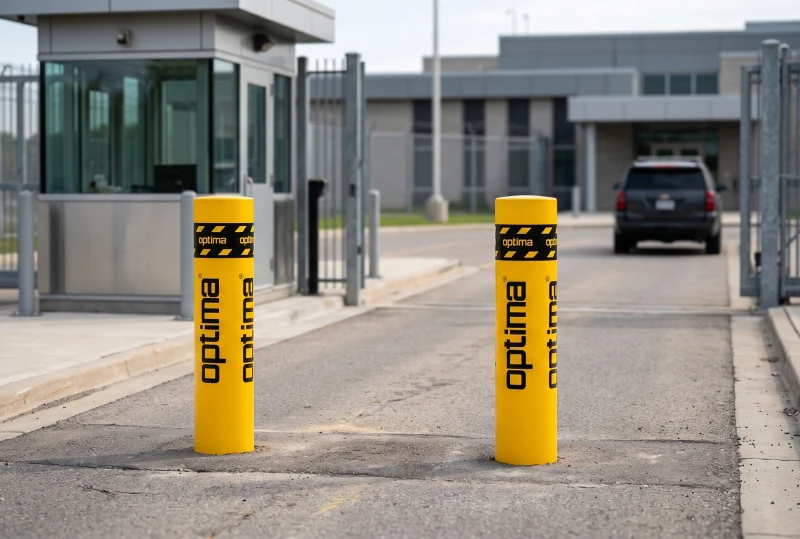
A bollard (also called an automatic or retractable bollard) is an automatic security barrier installed flush into the ground that rises to physically block a roadway against unauthorized vehicle access. Because its cylindrical body emerges from the ground when raised, it is commonly known as a “” bollard. Its applications range from residential and car-park entrances to military sites, public buildings and airports.
In this guide we explain how a bollard works, its types, the critical difference between crash-rated (anti-terror) and access-control models, the right selection criteria, and the engineering factors that drive its cost.
How Does a Bollard Work? (Working Principle)
A bollard consists of a movable cylindrical body and a drive unit that raises and lowers it. The system is buried in a housing below the surface; only the movable body rises above ground level.
The operating cycle has three basic steps:
- Trigger: Access is granted via remote control, card/RFID reader, license plate recognition (ANPR), push button or central control software.
- Movement: The drive unit (hydraulic, electromechanical or pneumatic) lowers the body to let the vehicle pass.
- Reset: After the vehicle passes, the body rises again and closes the road. A safety loop detector and photocells prevent it from under a vehicle.
In high-security models the bollard is designed to remain up even during a power failure, and offers a fast-closing feature (EFO – Emergency Fast Operation) for emergencies.
Types of Bollard
It is best to classify bollards along two axes: by drive type and by security level. This distinction is also the key to choosing the right product.
By Drive (Operating) Type
- Hydraulic bollard: Operates on oil pressure. The most durable and most common solution for heavy vehicles and high-traffic crossings. A single hydraulic unit can drive several bollards (a group).
- Semi-automatic / manual bollard: Works with a gas spring or a key lock; suitable for low-traffic points with limited electrical infrastructure.
- Fixed bollard: Does not move; used on permanently closed pedestrian/vehicle separation lines and for decorative restriction.
By Security Level (The Most Critical Distinction)
- Access-control bollard: Its purpose is authorization — managing who may pass. It controls vehicle flow at residential, car-park and plaza entrances. It is not certified against a deliberate vehicle attack.
- Crash-rated / anti-terror bollard: Its purpose is to physically stop a vehicle attack. Its impact resistance is documented by independent crash tests (IWA 14, PAS 68, ASTM F2656). It is mandatory for critical facilities.
Confusing these two categories is the most expensive mistake: an access-control bollard will not stop an attacking vehicle, while a crash-rated bollard can be needlessly costly for a low-risk car park.
Bollard or Road Blocker?
Both products serve the same purpose — preventing unauthorized vehicle entry — but they differ mechanically:
- A bollard provides point protection with a narrow cylindrical body; protection is usually formed by separating lanes or by lining up several bollards side by side. It offers aesthetic, flexible placement.
- A road blocker provides the maximum impact surface with a plate/block that rises across the full width of the road; it is preferred in the highest impact-energy scenarios.
At high-risk entrances these products are often used together. For a detailed comparison, see our Road Blockers guide.
Bollard Certifications: IWA 14, PAS 68 and ASTM F2656 (K Ratings)
When buying a crash-rated bollard, the thing to check is not the phrase “impact resistant,” but the independent test rating:
- IWA 14-1: International crash-test standard. It defines vehicle type, mass, speed and penetration distance together (e.g. V/7200[N3]/80).
- PAS 68: A UK-origin HVM (Hostile Vehicle Mitigation) standard referenced worldwide.
- ASTM F2656 (K ratings): US standard. K4, K8 and K12 correspond to different truck masses and speeds (K12 means stopping a vehicle of roughly 6,800 kg at about 80 km/h).
The most valuable result in a test is the “zero penetration” rating, meaning the vehicle did not pass the bollard at all. In its independent crash tests, Optima Engineering has documented zero-penetration results.
Bollard Applications
- Vehicle entrances of residential complexes and plazas
- Shopping-mall and car-park entries/exits
- Public institutions, municipal and courthouse buildings
- Military sites, police and critical infrastructure (energy, water, telecom)
- Airports, ports and border gates
- Vehicle restriction in pedestrian zones and historic areas
- High-risk private facilities such as embassies, banks and data centers
What to Consider When Choosing a Bollard
- Threat level: Is access control needed, or anti-terror protection? This determines the certification requirement.
- Traffic volume and speed: The number of daily cycles (duty cycle) drives the opening/closing time and the drive type.
- Body diameter and height: Selected according to the opening to be protected and visual/functional needs.
- Material: 304/316 stainless steel or electrostatically painted body; corrosion resistance matters in marine/coastal environments.
- Service and spare parts: Local manufacturing, warranty and after-sales support directly affect total cost of ownership.
Installation and Maintenance
A bollard requires a concrete foundation and proper drainage for the housing buried in the ground; therefore site preparation and infrastructure (electrical/control cabling) are critical before installation. Periodic maintenance should include hydraulic level/seal checks, photocell and loop-detector testing, and inspection of seals and surfaces. In areas with freezing risk, a heater and suitable hydraulic oil maintain performance.
Optima Engineering Bollard Solutions
Exporting to more than 40 countries since 2001, Optima Engineering manufactures high-security barrier systems developed in its own design center that have achieved zero-penetration results in independent crash tests. From access control to anti-terror protection, you can review the bollard solutions suited to your site and the entire high-security product family, and download the current product catalog.
Related Content
Frequently Asked Questions
What does a rising bollard do?
It physically prevents unauthorized vehicle passage and controls vehicle flow at entry points. It is used at security levels ranging from access management to anti-terror protection.
What is the difference between a rising bollard and a road blocker?
A rising bollard provides point protection with a narrow cylindrical body and offers flexible placement. A road blocker creates a wider impact surface with a plate that rises across the full road width and is preferred in the highest impact-energy scenarios.
What is the difference between a hydraulic and an electromechanical rising bollard?
Hydraulic models run on oil pressure and are more durable for heavy vehicles and high traffic. Electromechanical models run on an electric motor and offer lower maintenance and energy use at medium traffic levels.
What does “crash-rated rising bollard” mean?
It means a bollard whose stopping performance against a specific vehicle mass and speed is documented by independent crash tests (IWA 14, PAS 68, ASTM F2656). Classes such as K4, K8 and K12 express different impact resistances.
Does a rising bollard work during a power outage?
High-security models are designed to remain in the closed (raised) position when power is lost. Fast-closing (EFO) and manual override solutions can be provided for emergencies.
How many seconds does a rising bollard take to lower and rise?
Depending on the model and drive type, a normal cycle takes a few seconds; emergency (EFO) models can close much faster, in under a second.
What determines the price of a rising bollard?
The security/certification class, drive type, body material and dimensions, quantity, integration accessories, and site and installation conditions are the main factors that determine price.
Can a rising bollard be integrated with a license plate recognition system?
Yes. It can be designed to work with license plate recognition (ANPR), card/RFID access, electronic toll tags, remote control and central control software.
What is required to install a rising bollard?
A concrete foundation, proper drainage and electrical/control cabling are required for the housing buried in the ground. Site preparation before installation is critical for performance and service life.
After Sales Services
Your Assurance in Quality, We Are With You in Support
OPTIMA that has adopted it as its principle to keep customer satisfaction on the forefront by launching the products whose quality standards are at utmost levels on the markets is always there for you with its after-sale support services.


